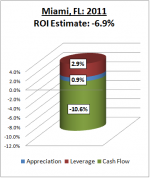
Miami, FL: -6.9% Return on Investment (2011)
Miami represents one of the most notorious bubble markets in the entire United States. Its prodigious rise and precipitous decline have served as a warning sign for the potential disaster that can await investors attempting to time value bubbles. However, Miami is also a unique market area, since it is segmented between two distinctly different classes of properties. These two classes are single-family homes and high-rise condominiums. The importance of distinguishing between the two comes from the fact that high-rise condominiums bore the brunt of Miami’s value free-fall, and single-family homes are showing signs of stabilization. Currently, approximately 42% of Miami’s home inventory is coming from foreclosures[1].
The collapse of values in Miami began in 2007 and continued through 2010, as properties were lost to foreclosure at record rates. Most of the value collapse in Miam
i was driven by the high-rise condominiums that came to exemplify the real estate bubble. For investors who purchased at the market highs, Miami has been a roller coaster ride of value destruction as leveraged losses escalated higher and higher. As 2011 begins to unfold, many forecasts are indicating that Miami will begin to approach its cyclical bottom.
Upon hitting their cyclical bottom, it is likely that Miami will regress back toward a very modest rate of long-term appreciation. This process will be impacted by the release of foreclosure inventory that is being held by banks in the hopes that it can be introduced to the market after values have stabilized. There is a slight possibility that investors who buy into Miami at the right time can realize some value appreciation that comes from regression back to fundamentals off the cyclical value bottom. However, cash flow from properties in Miami is still quite low, relative to the current market values. This makes investment in Miami a very risky gamble of timing the value cycle.